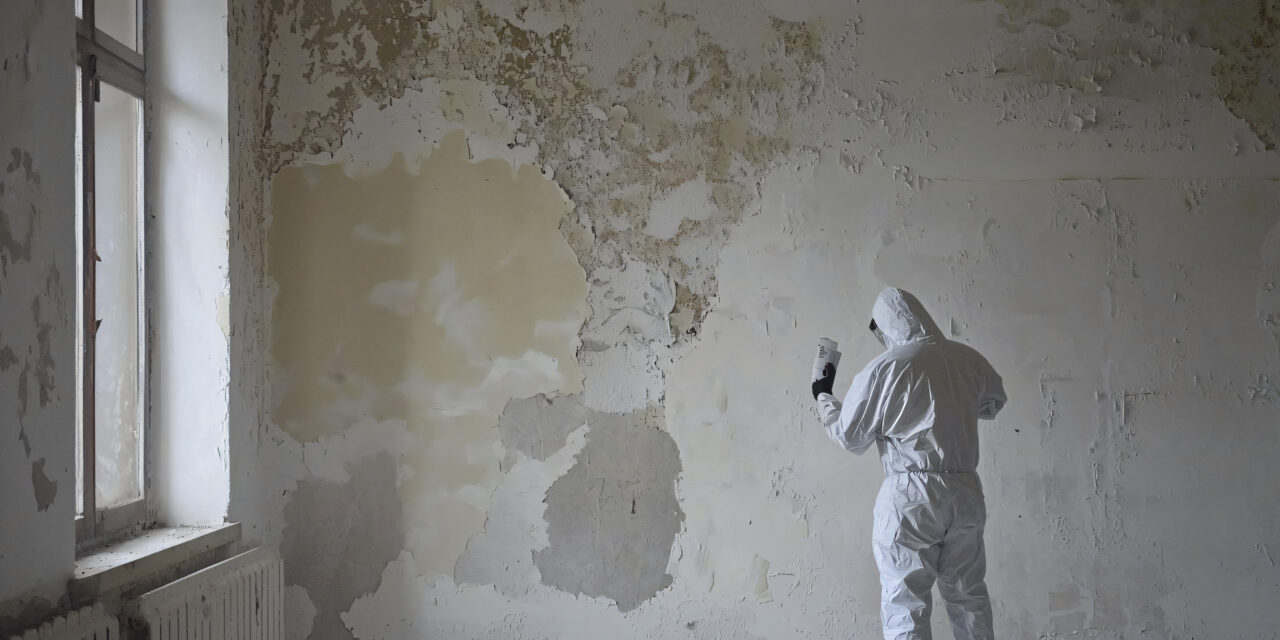
North Wales has a rich and varied built environment. Victorian and Edwardian terraces line the seafronts of Llandudno and Rhyl. Mid-century commercial blocks and industrial units are found throughout Wrexham and the surrounding area. Schools, churches, community halls and public buildings of all ages sit in towns and villages across the county. A significant proportion of this building stock was constructed during the decades when asbestos was routinely used in construction, and that has real, ongoing implications for anyone responsible for managing or working in these properties today.
How Common Is Asbestos in North Wales Buildings?
Asbestos was used extensively in UK construction from the 1950s through to the 1999 ban. It appeared in a wide range of building materials including corrugated roof sheets, ceiling tiles, floor tiles and floor adhesives, pipe lagging, spray-applied fire protection coatings, textured finishes such as Artex, insulation board around structural steelwork, and certain plaster products. Any building constructed or significantly refurbished before 2000 may contain asbestos-containing materials (ACMs). In practice, a very large proportion do.
This applies across the full range of building types found in North Wales. Schools built in the 1960s and 1970s frequently contain asbestos in ceiling tiles and service ducts. Victorian and Edwardian commercial premises often have asbestos-containing materials added during twentieth-century refurbishments. Industrial buildings from the mid-century period regularly used asbestos insulation board and corrugated asbestos roofing. The variety is wide, and assumptions about a building’s age or appearance are not a reliable substitute for a professional survey.
Is Asbestos Always Dangerous?
Not in all circumstances. Asbestos-containing materials that are in good condition, well maintained and undisturbed generally present a low risk. The hazard arises when fibres become airborne, which happens when materials are damaged, deteriorating or disturbed during maintenance or building work. Inhaled asbestos fibres can cause mesothelioma, asbestosis and lung cancer, diseases that typically develop many years after exposure and are in most cases fatal. Around 5,000 people in the UK die each year from asbestos-related diseases, more than from any other occupational health cause.
The key point for building owners and managers is this: knowing what is present and managing it responsibly is far safer than leaving it unidentified. An asbestos survey is the starting point for that process.
What Are Your Legal Obligations?
Regulation 4 of the Control of Asbestos Regulations 2012 places a legal duty to manage asbestos on anyone responsible for the maintenance or repair of non-domestic premises. This includes employers, landlords, managing agents and facilities managers. The duty applies regardless of whether any building work is planned. Simply being responsible for the premises is enough to trigger the obligation.
Meeting the duty means having an up-to-date asbestos survey, a written asbestos management plan, a process for monitoring the condition of known ACMs and making this information available to anyone carrying out maintenance or repair work on the building. The management plan must be kept current and reviewed whenever there is reason to believe conditions may have changed.
If building or refurbishment work is being planned, a separate refurbishment survey is legally required before work begins in the affected areas. Discovering asbestos mid-project is disruptive and costly, and in some cases can bring a project to a complete stop.
Types of Asbestos Survey
There are three main types of Acredited asbestos surveys in North Wales and across the UK. A management survey covers the building in normal use and identifies ACMs that could be disturbed during routine maintenance. A refurbishment survey focuses on the areas to be affected by planned works and must be carried out before contractors begin. A demolition survey is the most comprehensive type, covering the entire structure before it is demolished to ensure all asbestos is safely removed first. All three types are carried out in compliance with HSG264, the HSE’s official asbestos survey guidance.
Finding a Competent Surveyor in North Wales
UKAS accreditation is the standard to insist on. It confirms that the company has been independently assessed by the United Kingdom Accreditation Service and continues to be monitored. Surveyors should also hold BOHS professional qualifications, the formal certificates issued by the British Occupational Hygiene Society confirming individual competency.
JB Monitor are a UKAS-accredited asbestos surveying company based in Colwyn Bay, covering all of North Wales and the North West. Their UKAS accreditation numbers are 0294 for surveying and 2075 for laboratory analysis, both verifiable at ukas.com. All surveyors hold BOHS qualifications, and their in-house Colwyn Bay laboratory provides fast sample turnaround. They carry out management, refurbishment and demolition surveys and also offer air monitoring, bulk sampling, awareness training and full asbestos consultancy for organisations managing ongoing compliance requirements.
North Wales: 01492 536 444 | Manchester: 0161 359 3684
www.jbmonitor.co.uk