The environment is an incredibly hot topic at the moment. Whether you care about it or not, you might be interested to know that opting for environmentally friendly options can actually save you quite a bit of money.
Reducing our impact on the environment doesn’t have to mean running into the woods and living off whatever we can find for the rest our lives – little changes such as changing the lighting in your home to LED lights and LED strips can make a world of difference.
LED stands for ‘light-emitting diode’. They were first invented in the early 1900s, but were not developed for practical uses until the 1960s. With the ever increasing advancements in technology, LED lights are taking over traditional methods – especially within commercial and industrial settings. LEDs are now being used to light up streets and supermarkets, due to the number of benefits they provide over fluorescent and incandescent bulbs.

LED lighting is often used decoratively.
LED lighting has a number of benefits towards the environment, as well as your pocket. This is because of their fantastic efficiency, being up to 80% more efficient than the traditional fluorescent and incandescent lighting options. Quite a big difference!
LEDs emit a higher amount of lumens per watt than traditional bulbs. This means you won’t have to have as many lights installed within your home. Lumens are a measure of the total visible light from a light source – the higher the lumens, the better.
LED lights are more efficient because they require a much lower wattage than their traditional counterparts. The low amount of energy used means that not only are they more beneficial to the environment; they’ll also significantly reduce your energy bills.
Over their lifespan, LED lights will typically consume 500 KWh of electricity, whereas incandescent bulbs use up a huge 3000 KWh. Depending on your electricity costs, this number can really add up. Whilst incandescent bulbs might be cheaper to purchase initially, there’s a good chance you’ll be paying more in your electricity bills over the months.
Fluorescent light bulbs contain small amounts of mercury, which is a toxic chemical element. Not only can it be harmful to humans, it can impact the environment. LED lights contain no harmful chemicals – another win for LED.
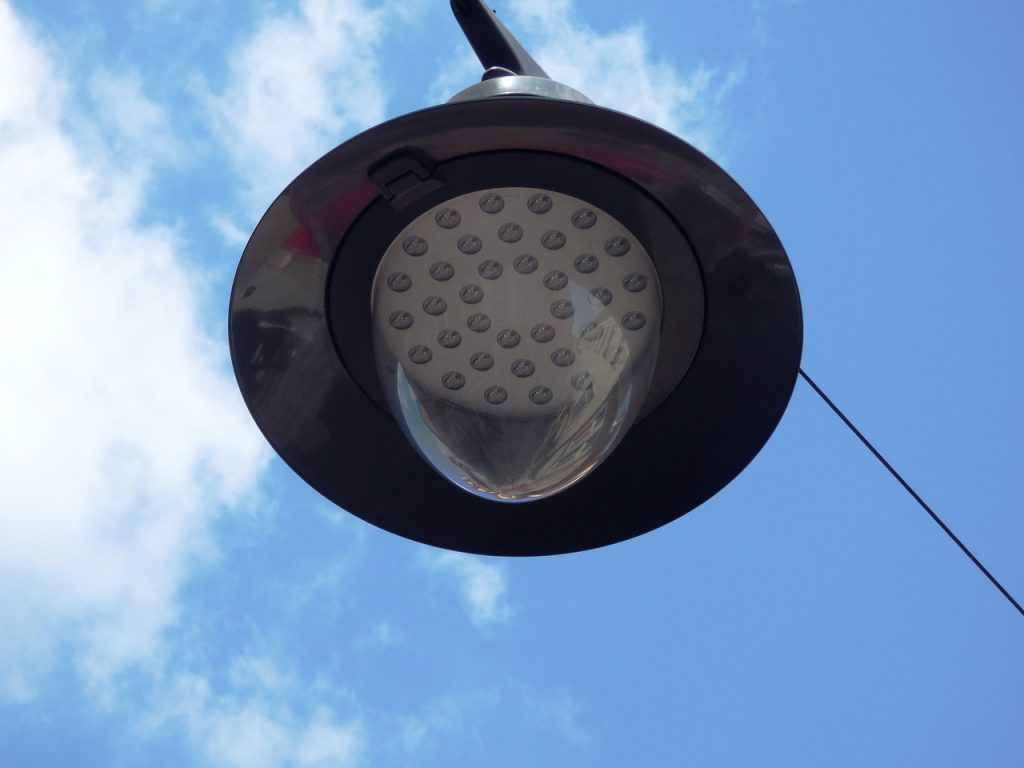
LED Lighting is used within street lights.
The lifespan of LED lights is also much longer than fluorescent and incandescent bulbs. On average, LED lights have a lifespan of 50,000 hours. To compare, on average an incandescent light bulb will last between 1,000 to 2,000 hours.
Since they last for so long, you won’t have to keep spending money (and time) on replacing them. This means that fewer bulbs will end up chucked into landfills. As an added benefit, many LED lights are completely recyclable.
LEDs, unlike fluorescent light bulbs give off very little heat, and can be altered to change to almost every colour imaginable. This makes them fantastic for growing plants indoors, and multiple studies have proved so.
LED light fixtures are also much more robust than their traditional counterparts. Fluorescent bulbs are incredibly fragile, and it doesn’t take much to break the glass on them. A more robust light means it’s unlikely you’ll have to replace it often, cutting down on the amount of bulbs which need to be manufactured – which in turn helps to reduce the energy usage with factories.
LEDs are designed and manufactured in a range of different shapes, sizes and colours. One LED light can be programmed to change to a number of different colours, which is great if you want to create a mood lighting within your home, without having to change or buy new bulbs every time.